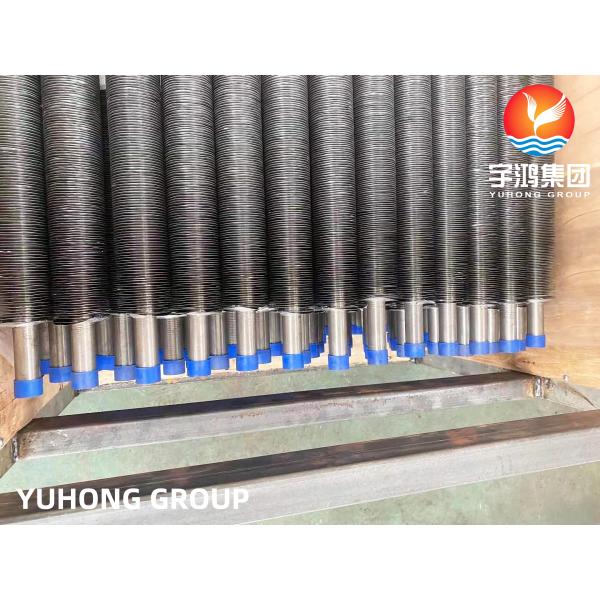
NICKEL ALLOY FINNED TUBE EMBEDDED G-FIN TYPE SB163 MONEL 400
Advantage of Fin Tube
Transferring heat from a hot fluid into a colder fluid through a
tube wall is the reason many of us use finned tubes. But you may
ask, what is the major advantage of using a finned tube? Why can’t
you just use a regular tube to make this transfer? Well you can but
the rate will be much slower.
By not using a finned tube the outside surface area is not
significantly greater than the inside surface area. Because of
that, the fluid with the lowest heat transfer coefficient will
dictate the overall heat transfer rate. When the heat transfer
coefficient of the fluid inside the tube is several times larger
than that of the fluid outside the tube the overall heat transfer
rate can be greatly improved by increasing the outside surface area
of the tube.
Finned tubes increase outside the surface area. By having a finned
tube in place, it increases the overall heat transfer rate. This
then decreases the total number of tubes required for a given
application which then also reduces overall equipment size and can
in the long-run decrease the cost of the project. In many
application cases, one finned tube replaces six or more bare tubes
at less than 1/3 the cost and 1/4 the volume.
For applications that involve the transfer of heat from a hot fluid
to a colder fluid through a tube wall, fin tubes are used. Usually,
for an air heat exchanger, where one of the fluids is air or some
other gas, the air side heat transfer coefficient will be much
lower, so additional heat transfer surface area or a fin tube
exchanger is very useful. The overall pattern flow of a finned tube
exchanger is often crossflow, however, it can also be parallel flow
or counterflow.
Fins are used to increase the effective surface area of heat
exchanger tubing. Furthermore, finned tubes are used when the heat
transfer coefficient on the outside of the tubes is appreciably
lower than that on the inside. In other words, heat transferred
from liquid to gas, vapor to gas, such as steam to air heat
exchanger, and thermic fluid to air heat exchanger.
SB 163 N04400 Nickel based ASME SB 163 UNS N04400 pipe is known for
its resistant to seawater and steam at high temperaturesas.
Embedded G-Type Finned Tube Features:
- 1. Compact design
- 2. High-performance
- 3. Easy installation
- 4. Less space required
- 5. Less cabling
- 6. Optimized surface
- 7. Finest technology used
- 8. Average corrosion protection
- 9. Less energy consumption
- 10. Increased reliability
- 11. Low maintenance
- 12. High mechanical resistance
Processes of G-type Finned Tube
In G-type finned tubes, the fins are prepared by embedding the
metal strip into a groove. The latter is formed on a base tube.
Placing the fin on it, back-filling is done – resulting in strong
attachment of the fins to the base tubes. Hence, the name G-Fin
Tubes has come up. The three processes mentioned above are carried
out simultaneously. Maximum heat transfer is expected out of the
g-fin tubes as the fins are strongly attached to the base tube.
The G-type finned tubes usually work at high temperature (with
around 400 degree Celsius) applications. Made of copper, carbon, or
aluminium, these fins have comparatively less resistance towards
atmospheric corrosion. On the other hand, mechanical resistance is
acceptable. Stainless steel and carbon steel fin materials are also used, but particular
processing and tooling of the steel fin strips are necessary. Air
coolers, radiators, etc use the g-fin tubes.
Technical Details/Base Tube Details
- Tube Diameter : 20 mm OD Min to 219 mm OD Max.
- Tube Thickness : Minimum 2 mm up to 16mm
- Tube Material : Carbon Steel, Stainless Steel, Alloy Steel, Corten
steel, duplex Steel, Super Duplex Steel, Inconel, High Chrome High
Nickle & Incolloy, CK 20 material and some other material.
About Monel 400 Base Tube
Monel belongs to a group of nickel alloys. It is produced with high
concentrations of copper and chromium in their chemical
composition. These tubes are designed to suffice in corrosion
stress-induced environments. They don’t easily dissociate or deform
under any temperatures. The SB 163 N04400 grade is designed with superior strength and excellent mechanical
properties. They possess a minimum tensile strength of 550Mpa and a
minimum yield strength of 240Mpa. The products from this grade can
be easily elongated by 40%.
Monel 400 is a nickel-copper alloy (about 67% Ni – 23% Cu) that is resistant
to sea water and steam at high temperatures as well as to salt and
caustic solutions. Alloy 400 is a solid solution alloy that can
only be hardened by cold working. This nickel alloy exhibits
characteristics like good corrosion resistance, good weldability
and high strength. A low corrosion rate in rapidly flowing brackish
or seawater combined with excellent resistance to stress-corrosion
cracking in most freshwaters, and its resistance to a variety of
corrosive conditions led to its wide use in marine applications and
other non-oxidizing chloride solutions.
Chemical Composition
| Grade | C | Mn | Si | S | Cu | Fe | Ni | Cr |
| Monel 400 | 0.30 max | 2.00 max | 0.50 max | 0.24max | 28.0-34.0 | 2.50 max | 63.00 min | – |
Mechanical Properties
| Element | Density | Melting Point | Tensile Strength | Yield Strength (0.2%Offset) | Elongation |
| Monel 400 | 8.8 g/cm3 | 1350 °C (2460 °F) | Psi – 80,000 , MPa – 550 | Psi – 35,000 , MPa – 240 | 40 % |
Physical Properties
| Properties | Metric | Imperial |
|---|
| Density | 8.8 gm/cm3 | 0.318 lb/in3 |
Industries of G-Type Finned Tubes
- Rubber plants
- Power plants
- Petroleum industries
- Chemical industries
- Marine engineering.
- Chemical and hydrocarbon processing equipment.
- Gasoline and freshwater tanks.
- Crude petroleum stills.
- De-aerating heaters.
- Boiler feed water heaters and other heat exchangers.
- Industrial heat exchangers.
- Chlorinated solvents.
- Crude oil distillation towers.